
What Talladega County Deed Records Convey
Instrument type comes first. A recording can affect Talladega County land without moving full ownership, and Probate accepts many land instruments besides deeds. Read the document's role in the index against the actual image before calling anything a transfer.
| Deed type | What it generally does | Common research use |
|---|---|---|
| Warranty or special-warranty deed | Conveys the stated interest with described covenants | Follow a purchase transfer |
| Quitclaim deed | Conveys whatever interest the grantor may hold | Resolve or release a claimed interest |
| Executor or administrator deed | Conveys under estate authority | Connect probate administration to land |
| Foreclosure deed | Records a sale following an enforcement process | Trace the post-sale grantee |
| Plat or easement | Documents mapped lots or a limited use right | Interpret description and access |
Mortgages, assignments, satisfactions, judgment liens, tax liens, mechanic's liens, declarations, rights-of-way and lis pendens all belong in a thorough deed search. None of them is a deed transfer until the recorded image says so.
Walk Talladega's Grantor-Grantee Index
The Probate portal supports name, date-range and book/page searches, party-role filters, a Starts With option and instrument-type selection. Anchor your Talladega County search on the current acquisition, keep the legal description constant, and follow the chain backward.
- Find the present owner's acquisition with that owner as grantee.
- Read the grantor, recording date, legal description and cross-reference.
- Search that grantor as a grantee in an earlier instrument.
- Repeat name variants and compare acreage through every step.
- Move to deed books or microfilm when web coverage ends.
- Grantor
- The party conveying the stated interest.
- Grantee
- The party receiving it.
- Chain of title
- The linked instrument sequence.
- Book/page or instrument number
- The reference used to retrieve a recording.
Talladega Probate's Exact Search Controls
The official instructions draw a line between a Starts With lookup and a contained-term name search. Instrument Type is separate from Book Type. You can filter results, sort by file date, and switch between expanded and condensed views. You can also select pages for a document cart. Starting August 1, 2026, online research requires a free account. A Pay-Per-Document option is also described.
| Control | Purpose | Use carefully |
|---|---|---|
| Grantor/grantee/assignee | Sets the party's document role | Search all roles if uncertain |
| Starts With | Matches beginning terms | Unchecked search is broader |
| Instrument type | Narrows document category | Multiple values use Ctrl |
| Book/page | Retrieves a known reference | Not the parcel identifier |
Note: The online cutoff and the official copy price are not published, so confirm both directly with Talladega County Probate.
The Verified 1833-1909 Deed Run
FamilySearch catalogs Talladega deeds and the general index from 1833 through 1909. That range lives in the historic catalog, not necessarily the live portal. The Alabama Archives county database pinpoints microfilm by county and record type, while most originals stay with the originating office. Lot and block chains need plat references. Rural chains need section-township-range calls or metes and bounds. Changed acreage can signal a split or combination. Treat catalog entries as discovery tools, never certified copies.
Releases and Cross-References Matter
Run mortgages, assignments, satisfactions, judgment and tax liens, mechanic's liens, easements, rights-of-way and lis pendens alongside the Talladega deeds themselves. An original mortgage proves nothing about an unpaid balance; follow its cross-reference to any release. Court dockets may explain enforcement or quiet-title activity, but Probate holds the recorded land instrument.
R.E.A.A.C.T. Watches Recorded Names
The free R.E.A.A.C.T. alert notifies you when a new recording matches a registered personal or business name. It cannot prevent, validate or undo a fraudulent deed. Register the relevant name variants, then inspect the actual document behind any unexpected alert.
Historic District Names Can Unlock a Plat
Silk Stocking, Talladega College, North Street and Courthouse Square mark distinct address eras. Map labels like Greystone, Stonehill and Shocco Springs can supply search terms, but a zoning label is no proof of a recorded subdivision. Verify the plat through Probate before trusting the name.
Get a Talladega County Deed Copy
Use the portal's page-selection and cart controls, or contact Probate at 256-362-4175, probate@talladegacountyal.org, P.O. Box 737, Talladega, AL 35161. Supply party names, the recording date, and instrument type. Include a book/page or instrument number. Ask about current plain-copy and certification charges instead of trusting an unofficial schedule. The official Probate source shows the interface.
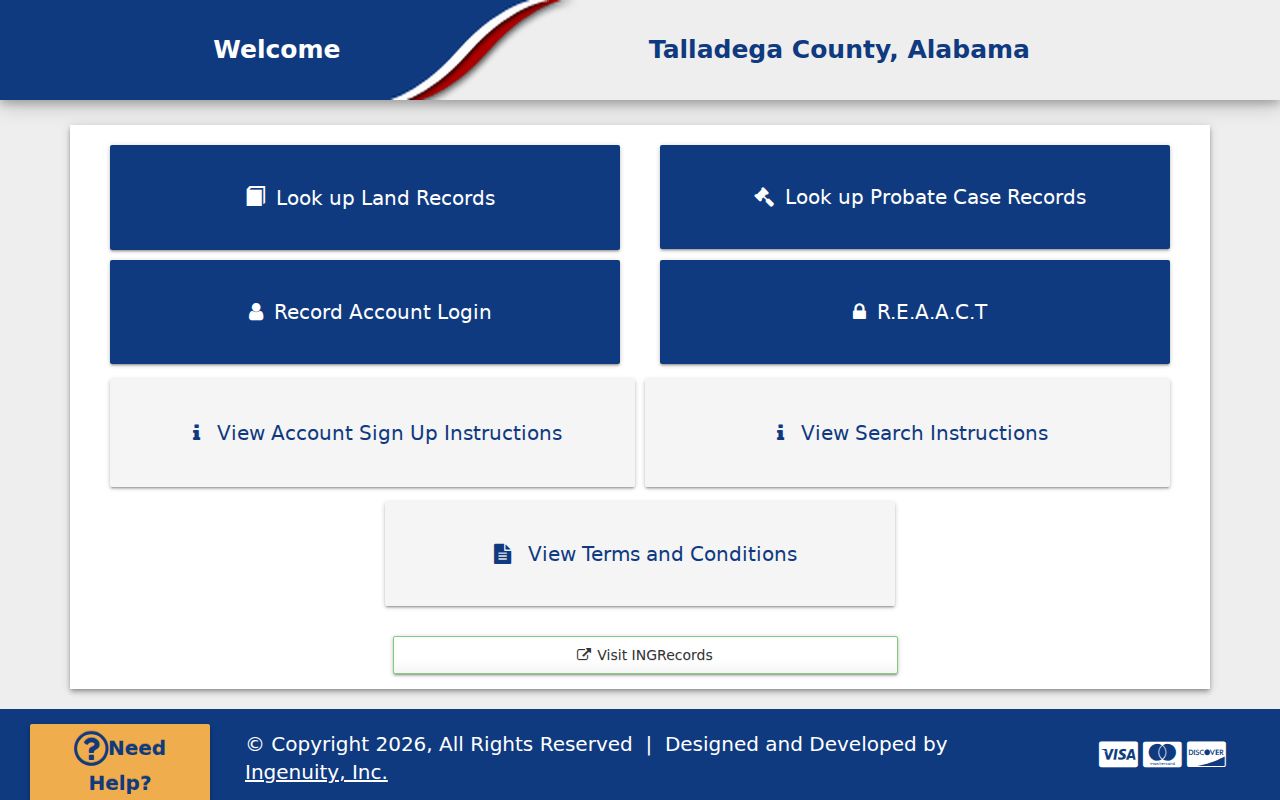
The landing page separates land records, probate cases, account access and the name-alert service.
Recorded, not guaranteed. Talladega County deed records show instruments accepted for recording, not every possible interest or defect. Obtain qualified title review before relying on ownership.
Separate an Index Entry From the Deed Image
A careful deed search in Talladega County should note the party names and their roles. Note the instrument type, the recording date, and the book and page or instrument number. Also note any legal-description clue and cross-references. Record the consideration only if the office displays it. Field names that a gated account portal does not show should not be guessed at.
The recorded image itself matters most. It can hold reservations, easements, marital language, and execution dates. It can also hold description exceptions that a short index result leaves out. Compare the recording date with the execution date. Confirm that the same land moves through the chain of title. That matters more than matching the same surname.
Estate Transfers Can Interrupt a Simple Name Chain
Executor and administrator deeds can explain a missing purchase deed under an heir's name. Wills, probate minutes and estate packets help too. FamilySearch catalogs a Talladega estate-filing index covering 1832 through 1994. Its probate minutes run from 1843 to 1929. Selected will series there start in 1833. These are leads to the Probate file, not substitutes for the conveyance itself. Search the decedent, the personal representative and the acquiring party. Compare the estate authority to the recorded deed. A quiet-title, partition or guardianship matter may need the local court file. It may also need the recording index.
Plats Connect Deed Language to the Ground
The county GIS includes Subdivision, SubLot, SubBlock, Lot Number, Book & Page and map annotation fields. Use those labels to find the relevant recorded plat. Then obtain the plat from Probate. GIS parcel lines are locating aids. They never replace the recorded description or a boundary survey. For metes-and-bounds deeds, keep every course, distance, monument, road right-of-way and section-township-range call. For lot and block deeds, keep the full subdivision name, phase, lot and plat reference. Simplifying either form too early can join the wrong Talladega County parcels.
Use the Probate Counter When Online Coverage Ends
The portal lists no earliest indexed year. It posts no official charges either. Call the Recording Office at 256-362-4175 or email probate@talladegacountyal.org. A written request can go to P.O. Box 737, Talladega, AL 35161, or ask about in-person inspection at the county office. Give the party names and roles, instrument type, approximate date, book/page or instrument number, and enough legal description to distinguish the parcel.
Ask where the book lives. It may sit online, on a public terminal, or as a paper volume or microfilm. Request each document separately when a chain includes a deed, mortgage, assignment, release, plat, or court-related filing. An index entry can omit pages, exhibits, exceptions, and cross-references visible in the image. Certification is a separate service. Current charges should come from Probate rather than an unofficial fee list.
Alabama Archives and FamilySearch help locate historic material. The Talladega Armstrong-Osborne Library's genealogy room and its newspaper microfilm can explain name and address changes. Treat them as supporting sources. The originating office still issues the official recorded copy.
Check Court and Probate Files Without Replacing the Deed
Court files often explain a recorded conveyance. A quiet-title, partition, foreclosure, boundary, lien-enforcement, or condemnation case can sit behind it. Talladega County sits in Alabama's 29th Judicial Circuit. The circuit offers northern and southern division access. Note the case number, division, parties, filing date, judgment, and public docket events. Then return to the recording index for the final instrument.
Estate transfers carry their own paper trail. Look for a will, letters, petition, sale authority, and an executor or administrator deed. A judgment or probate order is not automatically the deed that placed title in a later grantee. Compare the legal description and recording reference across both files. Respect sealed or redacted material.
Keep a Talladega County Deed Chain Audit Trail
Log every link in the deed chain. Record the exact query, party role, name spelling, instrument type, recording date, book/page or instrument number, cross-reference, and legal description. Note the evidence type too. Index metadata, a document image, a catalog entry, and a certified copy carry different weight, and the distinction keeps a compact search row from standing in for every deed page reviewed.
Record rejected matches as well. Same-name parties can be separated by acreage, subdivision, mailing clue, spouse or entity wording, and the land description. A trust or LLC may need alternate punctuation plus a related state business record. Keep both dates when a deed was signed on one day and recorded later.
Finish with the GIS map. Compare the latest recorded instrument against the current GIS deed reference and owner field. Mismatches have ordinary causes. Recording lag, a recent transfer, a split, or an indexing difference can each produce one. Any conflict deserves a custodian check.
Recorded Dates and Signed Dates Tell Different Stories
A deed can be signed weeks before recording. Keep both dates when the recorder shows them. Use the recording date for index order and the signed date for transaction context. Cross-references, releases, and corrective instruments may appear later, so a narrow search around only one date can miss a related filing.