
Trace Former Talladega County Owners by Era
No single button prints an owner history. Former owners come out of an ordered chain of deeds. Take the newest matching conveyance and note its grantor. Then locate the deed by which that same person earlier bought the land. Keep the loop going. Along the way, check legal descriptions and book and page references. Also check parcel changes and estate instruments at every step.
| Source | Years It Covers | Where Held | What It Shows |
|---|---|---|---|
| Probate recording index | Current online cutoff not officially stated | Talladega Probate | Parties, roles, dates, type and references |
| Deed and general indexes | 1833-1909 verified catalog run | FamilySearch catalog / Probate originals | Earlier grantor-grantee pathways |
| Recorded plats | Varies by subdivision and volume | Probate Recording Office | Lot, block, streets and map references |
| Historic newspapers | Selected 1850s-1870s; Daily Home from 1966 | Library catalogs and holdings | Sale notices and names to verify in deeds |
Use the online portal for the modern span it covers. Older transfers live in indexed deed books and microfilm. A catalog or newspaper is a finding aid only, never the certified ownership record.
Repeat Talladega Names in Every Relevant Role
Probate's search page offers lookups by name, date range, and book and page. You can narrow results to Grantor, Grantee, Assignee, or all roles at once. "Starts With" limits matches to words beginning with the text you enter. Leave it unchecked for broader contained-term matching. Instrument Type sits apart from Book Type. Multiple instruments can be chosen with the Ctrl key.
Try spelling variants, initials, and entity suffixes when hunting for a name. Results can be filtered, sorted by file date, and expanded from a condensed list. Cross-references and image-page controls appear where available. Beginning August 1, 2026, Probate requires a free account for online access. The portal bars automated scraping.
Note: The portal confirms Pay-Per-Document access, but Probate publishes no current official dollar copy schedule.
Build a Talladega Deed-Chain Timeline Backward
| Transfer date | Grantor → grantee | Instrument | Reference to preserve |
|---|---|---|---|
| Newest | Current seller → current grantee | Warranty, quitclaim or other deed | Book/page or instrument number |
| Earlier | Prior owner → newest grantor | Acquisition deed | Legal description and cross-reference |
| Estate interval | Decedent/estate → successor | Executor or administrator deed | Related probate case |
| Subdivision origin | Developer → first lot grantee | Deed plus plat | Subdivision, lot, block and map page |
Treat the table as a method, not a claim about any one parcel. Fill each row only from the index and the recorded instrument, and flag every gap instead of guessing at a former owner.
Reconstruct the Talladega County Deed Chain
The key move is simple: turn the newest deed's grantor into the next search's grantee. Confirm every result covers the same legal description. A matching surname alone proves nothing.
- Use the current roll and deed reference to find the newest acquisition deed.
- Copy its grantor, grantee, date, instrument type, book/page and legal description.
- Search that grantor as grantee in an earlier date range, including name variants.
- Verify the same tract by description, plat reference and cross-reference, then repeat.
- At the online limit, continue through Probate-held books or the 1833-1909 cataloged indexes.
- Grantor / grantee
- The conveying and receiving parties named in an instrument.
- Chain of title
- The ordered sequence of recorded interests for the same land.
- Reverse index
- An index route organized by the receiving party, useful for finding acquisition deeds.
- Quitclaim / warranty deed
- Different conveyance forms; neither label alone proves an unbroken chain.
The Verified Talladega Historical Run Starts in 1833
FamilySearch catalogs Talladega County deeds and general indexes covering 1833 through 1909. The Alabama Archives' county-record guide covers county records. It notes that most physical records stay with their originating offices. Use catalog entries to spot likely volumes. Then ask Probate for the authoritative image or certified copy.
The Archives courthouse-fire list does not name Talladega. That is not proof every volume survives intact. Missing index entries can appear. Damaged pages and spelling variants also happen. Each calls for a wider date or book search rather than an assumption.
Use Alabama Archives as a Talladega Finding Aid
The Archives county-record resource shown below helps route older research.
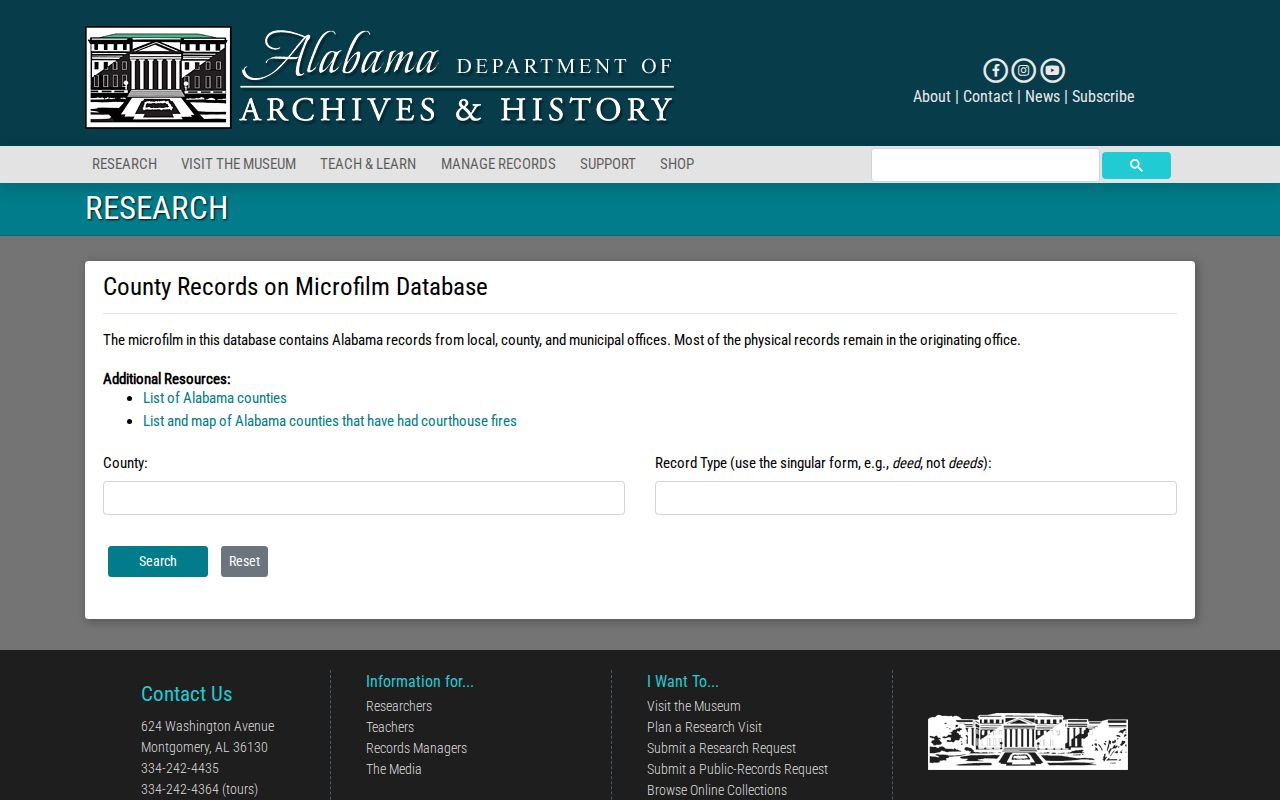
Archives guidance sits between the online cutoff and a local volume request. It never replaces the Talladega County deed held by Probate.
Follow Talladega Land Descriptions Through Change
Urban chains often cite a subdivision with lot and block. Rural chains lean on section, township, and range. They also add quarter sections, monuments, roads, bearings, and distances. Copy every description verbatim before simplifying anything. A lot split, combination, replat, or retired parcel ID can erase today's map key from an older deed. That can happen even where the land overlaps. Keep both versions side by side.
GIS fields like PreviousOwner, DeedBook, DeedPage, subdivision, and legal description offer useful clues. They do not add up to a historical chain. Compare the Talladega parcel map against the recorded plat whenever boundaries or numbering shifted.
Estate Transfers Can Interrupt a Simple Owner Chain
An executor's deed, a probate order, a guardianship action, or an estate sale can inject parties. Their names may differ from the decedent or the beneficiary. Talladega Probate handles both recording and probate under one local roof. Its landing page offers a land-record route and a probate-case route. Pull the deed first. Then use the case reference. Or use party names to sort out who had authority to sell.
A will or case filing can explain why a conveyance happened. It should not enter the chain as a transfer unless the land record supports it. The same caution covers mortgage releases, liens, and lis pendens. They mark the record trail without necessarily changing the former owner.
Old Talladega Newspapers Supply Name Variants
Cataloged newspaper runs include 19th-century Talladega titles. They also hold selected Sylacauga issues and The Daily Home from 1966. Legal notices, obituaries, and subdivision-sale ads can surface married names, estate representatives, developers, or old place names. Verify every lead in Probate's index and deed books. A newspaper is a pointer, not proof.
Historic local terms help widen an address-era search. Courthouse Square, North Street, Silk Stocking, and Talladega College all appear in old coverage. Lincoln's former Kingsville name works the same way for land in that area. Treat these as search terms, never as substitutes for a legal description.
Know Where Talladega Ownership Records Stop Online
The verified historical catalog reaches from 1833 to 1909. The current Probate portal publishes no earliest online year. Never fill that gap with an assumed cutoff. Search the portal for the period you need, then contact the Recording Office at 256-362-4175 or probate@talladegacountyal.org for older books, unavailable images, and certified copies.
Historical boundary. Online coverage is not officially stated. Use the 1833-1909 cataloged run and local deed books for time depth, and never invent a missing transfer.
Former-owner research supports house history, purchase diligence, estate work, and preservation. Do not use names or addresses to stalk, harass, or harm any living person. Get professional title help whenever an ownership conclusion carries legal or financial weight.
Audit Every Talladega Former-Owner Link
Before you place a person or business in the chain of title, put the instrument through four tests. Does it concern the same land? Did the party role actually convey or receive an interest? Does the recording date fit the sequence, and does any cross-reference redirect the search? A mortgage, release, lien, easement, lis pendens, or corrective deed can name an owner of record. It may do so without transferring the whole interest. Label each one for what it is. Do not force it into the transfer timeline.
Book and page numbers and legal-description continuity matter most when names repeat. The Talladega County Probate instructions allow role filters and date ranges. Even so, a broad name search may pull up an unrelated Talladega County parcel. Starts With helps with initials and name variants. Contained-term searching widens the result set. Remember that Instrument Type is not Book Type. Picking the wrong control can hide the deed you need.
When a historic parcel resists, compare current and former subdivision labels. Compare old and new parcel identifiers too, and any map-book annotations. A modern GIS PreviousOwner field is only a lead. A newspaper notice can identify an estate representative or developer. But it is a lead too. The controlling evidence comes from the deed, the recorded plat, or the probate order. It can also come from another instrument of record.
Keep a research log of searched names, roles, date ranges, references, image availability, and unresolved gaps. That log stops you from circling through the same index results. It also makes a counter request at the Probate office precise. Most of all, it keeps uncertainty visible. A chain with one missing acquisition is incomplete. It should be reported that way rather than smoothed over with an assumption.